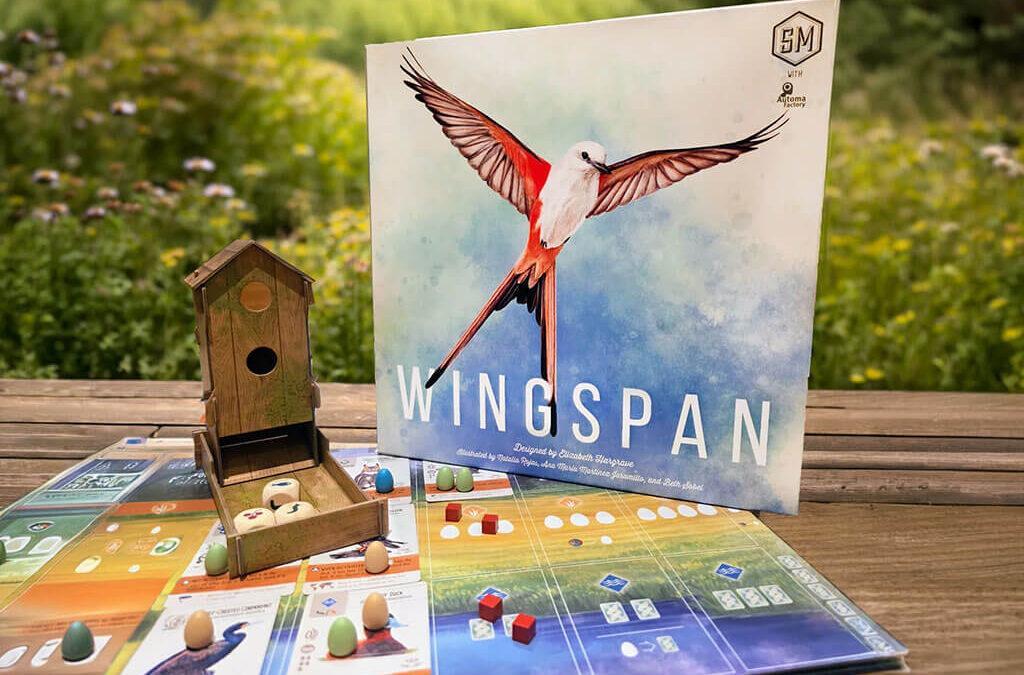

Wingspan turns a table full of bird enthusiasts into competing aviary managers, and it does so with some of the prettiest components you’ll find in a modern board game. Designed by Elizabeth Hargrave and published by Stonemaier Games, it sits in that sweet spot between a relaxed family game and a genuine engine-builder that rewards planning. If you’ve just unboxed a copy and the rulebook feels dense, this walkthrough covers how to play Wingspan from the first card you draw to the final point you tally.
The game handles 1 to 5 players, suits ages 10 and up, and runs roughly 40 to 70 minutes depending on player count and how prone your group is to overthinking. You’ll spend the whole game building a personal collection of birds, each one a small cog in a chain of combos that generate food, eggs and more cards. Let’s get a game to the table.
What is Wingspan and why has it stayed so popular?
Wingspan is a card-driven, engine-building game where every player develops an aviary split across three habitats: forest, grassland and wetland. You acquire birds, settle each one into the right habitat, and watch your board grow into a machine that feeds itself over four rounds. Its reputation was built partly on presentation, but the mechanics have held up: it landed a Kennerspiel des Jahres win in 2019 and has since spawned expansions covering Europe, Oceania, Asia and the Americas.
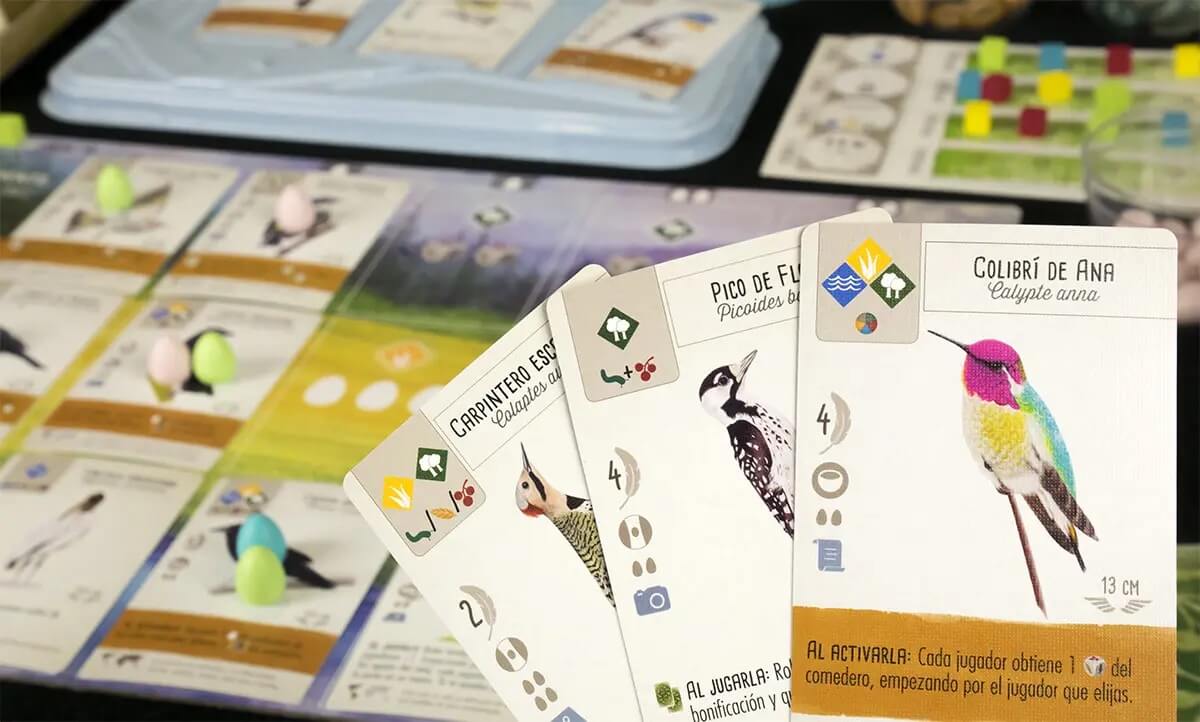
The theme is unusual for the hobby, and that has worked in its favour. Each card reads like a small field-guide entry for a real bird species, complete with wingspan measurements, nesting habits and diet. It’s the kind of game that draws in people who wouldn’t normally sit down for something with an engine at its core. The trade-off, which I’ll come back to later, is that experienced players sometimes find the card effects a little tame.
How long does a game of Wingspan take?
A typical game runs between 40 and 70 minutes, so plan for just over an hour with a full table. New players will land at the higher end while everyone learns the icons, and a two-player game moves noticeably faster because there’s less downtime between turns. Once your group knows the rhythm, the fixed number of turns keeps the length predictable — the game won’t balloon the way some engine-builders do once players master their combos.
Wingspan setup: getting the components on the table
Good Wingspan setup takes about five minutes once you know where everything goes. The box holds a lot of small pieces, so give yourself table space before you start. Here’s the order I use every time:
- Shuffle the bird deck (blue-backed cards) and place it beside the bird tray. Deal three face-up cards into the tray’s slots.
- Shuffle the bonus cards (green-backed) and set the deck in the middle of the table.
- Build two supply piles: one for the five food tokens (fish, berries, invertebrates, rodents and seeds) and one for the eggs.
- Assemble the birdfeeder dice tower and drop all five food dice into the tray at its base.
- Place the goal board in the centre. Pick a side first — the green side scores competitively by ranking players 1st, 2nd and 3rd, while the blue side is gentler. For a first game, use the blue side.
- Shuffle the goal tiles face down and slot one into each of the four spaces on the goal board. They’re double-sided, so either face is fine.
- Give every player a player mat, 8 action cubes in their colour, 5 bird cards, 2 bonus cards, and one of each food token.
Now each player makes two quick decisions before the first turn. Look at your five bird cards and decide how many to keep — you discard one food token for every card you hold on to, so keeping all five costs you all five tokens. Then look at your two bonus cards and keep just one, discarding the other. Choose a starting player, hand them the first-player token, and you’re ready.
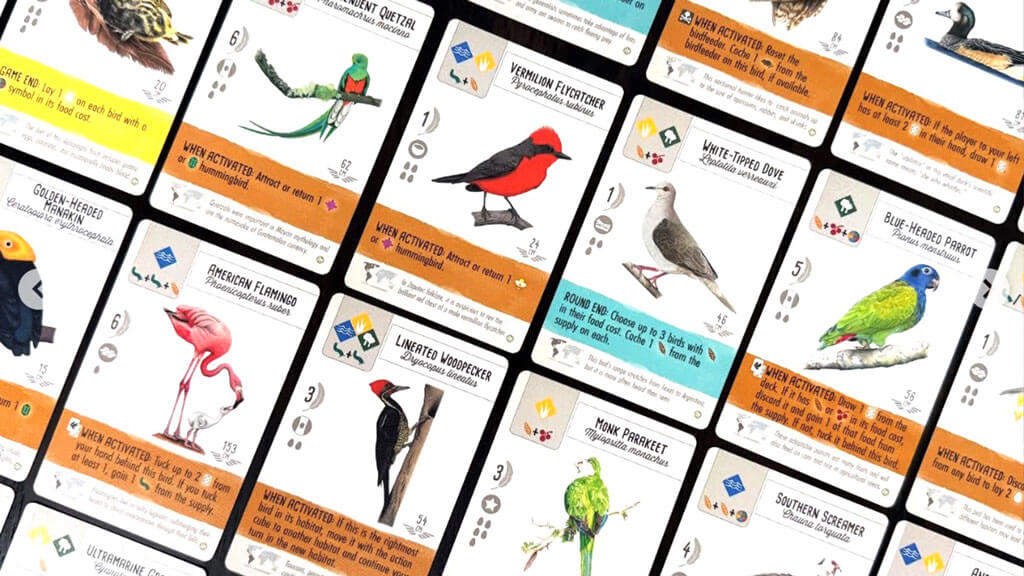
Insider tip: when you’re deciding which cards to keep during setup, check whether your starting food tokens can actually pay for the birds in your hand. A cheap bird you can play in round one is worth more than an expensive one you’ll sit on for three rounds waiting to afford.
How to play Wingspan: the four actions explained
Once you know the setup, learning how to play Wingspan comes down to understanding four actions and when to use them. The game runs over four rounds, and each round gives players a shrinking number of turns: 8 in round one, then 7, then 6, then 5. On every turn you pick one of four actions and place an action cube to mark it. Three of those actions are tied to a habitat row, and here’s the core idea that makes the game click: the more birds you have in a habitat, the more powerful that habitat’s action becomes.
Play a bird card
To play a bird, pay its food cost (shown top-left on the card) and place it in the leftmost open slot of the matching habitat row. Columns further right on your mat also cost eggs — between 0 and 2 — which you spend from birds already on your board. Some birds accept a wild food symbol, and you can always swap two identical food tokens to stand in for a single token of another type. You may only play one bird per turn.
Birds are the engine. Beyond the fixed points printed on each card, they carry three kinds of powers: brown habitat powers that trigger when you take that row’s action, white “when played” powers that fire once, and pink powers that trigger on your opponents’ turns. Playing a bird early matters, because you’ll activate its habitat power every time you use that row for the rest of the game.
Gain food (forest)
Taking the forest action lets you collect food tokens equal to the next open slot in that row. Each token you take must match a die currently in the birdfeeder — pick a die, take the matching token, and remove that die from the tower. When the birdfeeder empties, or when every remaining die shows the same face, roll all five dice back in. After gathering food, resolve the brown powers of your forest birds from right to left.
Lay eggs (grassland)
The grassland action lets you lay eggs equal to the next open slot. Place each egg on any bird on your mat, respecting the egg-capacity limit printed on each card. Eggs do double duty: you spend them to play birds in the right-hand columns, and any left on your board at the end score a point each. Then resolve your grassland birds’ powers, right to left.
Draw cards (wetland)
The wetland action lets you draw cards equal to the next open slot, taken from either the face-up tray or the top of the deck. There’s no hand limit, so hold as many as you like. If you drew from the tray, refill those slots from the deck after your turn. As with the other rows, resolve your wetland birds’ powers from right to left once you’ve drawn.
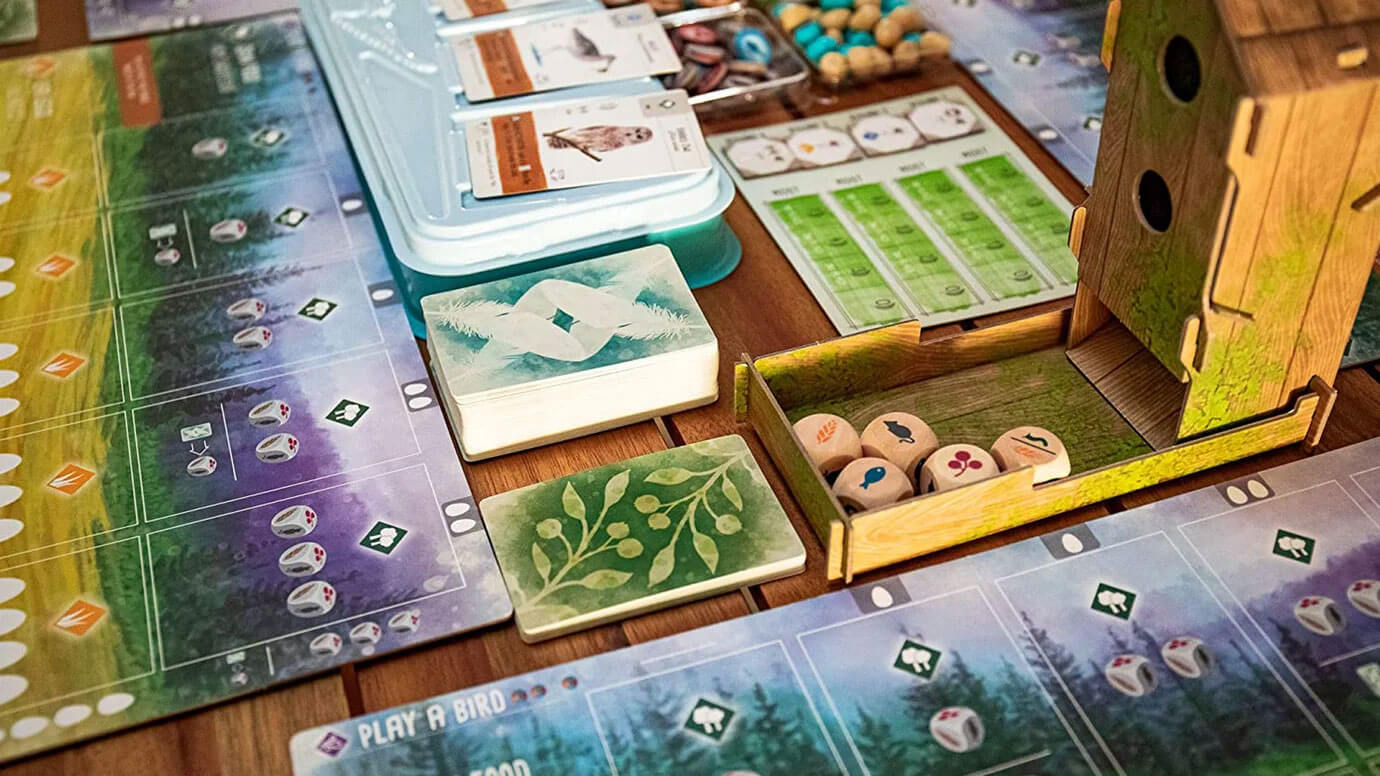
That right-to-left activation is borrowed from designs like Deus and Ginkgopolis, and it’s what makes Wingspan reward forward planning. A bird played in the first slot of a habitat gets activated again and again, so the timing of when you deploy each bird is as important as which bird you choose.
Ending a round and the flow of the game
A round ends once every player has used all their action cubes for that round. If it isn’t the fourth round, run a short cleanup: score the end-of-round goal, pass the first-player token one seat to the left, return everyone’s action cubes, then discard the bird tray and deal three fresh cards.
Scoring the round goal depends on which goal board you chose. On the green side, players place a cube on the 1st, 2nd or 3rd space based on how well they met that round’s goal — only those top three positions score, and ties share a position. On the blue side, each player places a cube according to how many of their birds meet the goal (up to five), and everyone scores independently. I’d strongly recommend the green side once you’re comfortable, because chasing those rankings is where most of the player interaction lives.
Caching and flocking
A handful of birds let you cache or flock, and both are worth understanding early. Caching means placing a food token from the supply onto a bird card, where it’s worth a point at game end. Flocking (also called tucking) means sliding a card from your hand or the deck underneath a bird, again worth a point each at the end. Both are quiet ways to rack up points that don’t rely on the main scoring routes.
Wingspan scoring: how to win the game
The game ends when the fourth round finishes, and Wingspan scoring pulls from several sources at once. Add everything up and the highest total wins. Here’s what counts:
- Points printed on each bird on your mat
- Points from the four end-of-round goals
- Points from your bonus card
- 1 point per egg sitting on your birds
- 1 point per food token cached on a bird
- 1 point per card tucked (flocked) under a bird
If two players tie, the one with the most unused food tokens in their personal supply wins; if they’re still level, they share the victory. Because a full game only gives you 26 actions total, scores tend to finish tight — which is exactly why ignoring the round goals is a fast route to losing, no matter how handsome your aviary looks.
Practical tip on Wingspan scoring: your bonus card is a compass from turn one. If it rewards, say, birds with cavity nests, weight your card draws toward that trait early rather than hoping the right birds show up in round four. The players who win consistently are usually the ones lining up their bonus card, the round goals and their board all at once.
Playing Wingspan solo and at different player counts
Wingspan supports 1 to 5 players, and the main thing that changes between counts is the number of turns per round rather than the rules themselves. Every player has their own mat, so more players simply means more mats and a tray that refreshes more often, letting you see a wider spread of birds across the game.
For solo play, every copy includes the Automa system — a deck of cards that runs a virtual opponent competing for the same goals you are. It’s a genuinely good solo mode, not an afterthought. In my experience two or three players is the sweet spot for the multiplayer game, mostly because downtime stays low and turns come around quickly.
Is Wingspan hard to learn?
Wingspan isn’t a heavy game, but the sheer number of icons can feel overwhelming on a first read. The box includes swift-start guides (grey-cornered cards plus a step-by-step sheet) that walk new players through their opening turns, and they’re worth using. The first player takes the Player 1 guide, and once everyone has played a few turns you shuffle the grey-cornered cards back into the deck. Give it one full game and the symbols stop being a barrier.
Is Wingspan worth adding to your collection?
If you already own something like Everdell, Terraforming Mars or Race for the Galaxy, the honest answer is that it depends on what you want from an engine-builder. Wingspan’s defining feature is its fixed number of turns, which stops the runaway snowball that can bloat other games in the genre once they’re mastered. That constraint forces you to make each turn count from the very first round rather than just building an ever-larger machine.
It’s not flawless. Players hunting for deep, spectacular card combos may find the effects a touch repetitive, since most birds optimise the same three actions or hand out points through simple means. Luck plays a role too — a bad run of draws can leave you short of the cards your bonus and goals need. But the flip side is that games are short enough to simply play again, and the fixed length keeps things sharp. For a beautiful, accessible game that leaves you wanting another round rather than exhausting the table, Wingspan earns its spot.
Learn how to play Wingspan properly, lean into the round goals, and you’ll find far more decision-making under the pretty surface than a first glance suggests.